EAP–ECPCP Position Paper Addresses Screen Time in Children and Adolescents
Building on this position paper, the European Academy of Paediatrics has written to European Commission President Ursula von der Leyen to share the perspective of European paediatrics on children’s screen time and social media use. EAP has offered its scientific and clinical expertise to support the development of evidence-based European policies that place children’s health and development at the centre of the digital transition.
Developed within the “Healthy Lifestyles for Youth” project coordinated by the members of the Young EAP, the paper draws on a narrative review of the scientific literature together with existing national and international policies to formulate coordinated, age-appropriate recommendations for paediatric societies, healthcare professionals, educators, policymakers and families.
The authors stress the importance of content quality over duration alone, protecting sleep, play and physical activity, and of practical habits, for all ages. Paediatricians should routinely address screen use during consultations and encourage open discussions with parents and caregivers about family media habits. The paper moreover emphasises the importance of a holistic and multidisciplinary approach, bringing together policymakers, paediatric societies, healthcare professionals, educational stakeholders, and families to promote effective and sustainable improvements in children’s health and well-being.
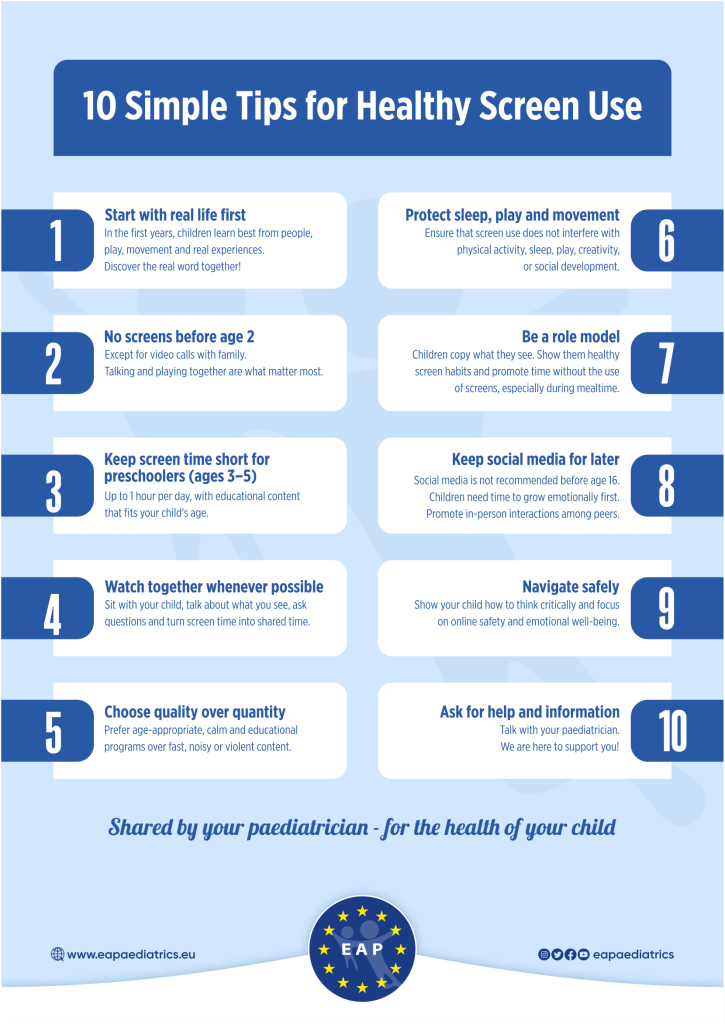
To help paediatricians translate these recommendations into practical guidance for families, a “10 Simple Tips for Healthy Screen Use” guide was included. Translated versions in 10 additional languages are available as downloadable resources, so that paediatricians across Europe can use them directly as parent-education material in their everyday practice.

New ways to test high-risk medical devices.
Manufacturers of medical devices need to test their products before being allowed to market them. Specifically, they require clinical data showing their medical device is safe and efficient. In this context, the EU-funded CORE-MD project will translate expert scientific and clinical evidence on study designs for evaluating high-risk medical devices into advice for EU regulators. The project will propose how new trial designs can contribute and suggest ways to aggregate real-world data from medical device registries.
It will also conduct multidisciplinary workshops to propose a hierarchy of levels of evidence from clinical investigations, as well as educational and training objectives for all stakeholders, to build expertise in regulatory science in Europe. CORE–MD will translate expert scientific and clinical evidence on study designs for evaluating high-risk medical devices into advice for EU regulators, to achieve an appropriate balance between innovation, safety, and effectiveness. A unique collaboration between medical associations, regulatory agencies, notified bodies, academic institutions, patients’ groups, and health technology assessment agencies, will systematically review methodologies for the clinical investigation of high-risk medical devices, recommend how new trial designs can contribute, and advise on methods for aggregating real-world data from medical device registries with experience from clinical practice The consortium is led by the European Society of Cardiology and the European Federation of National Associations of Orthopaedics and Traumatology, and involves all 33 specialist medical associations that are members of the Biomedical Alliance in Europe.