The survey asks about the toolkit’s relevance, usability and overall usefulness. Feedback received at this stage will help UNICEF refine the toolkit’s structure, presentation and user experience.
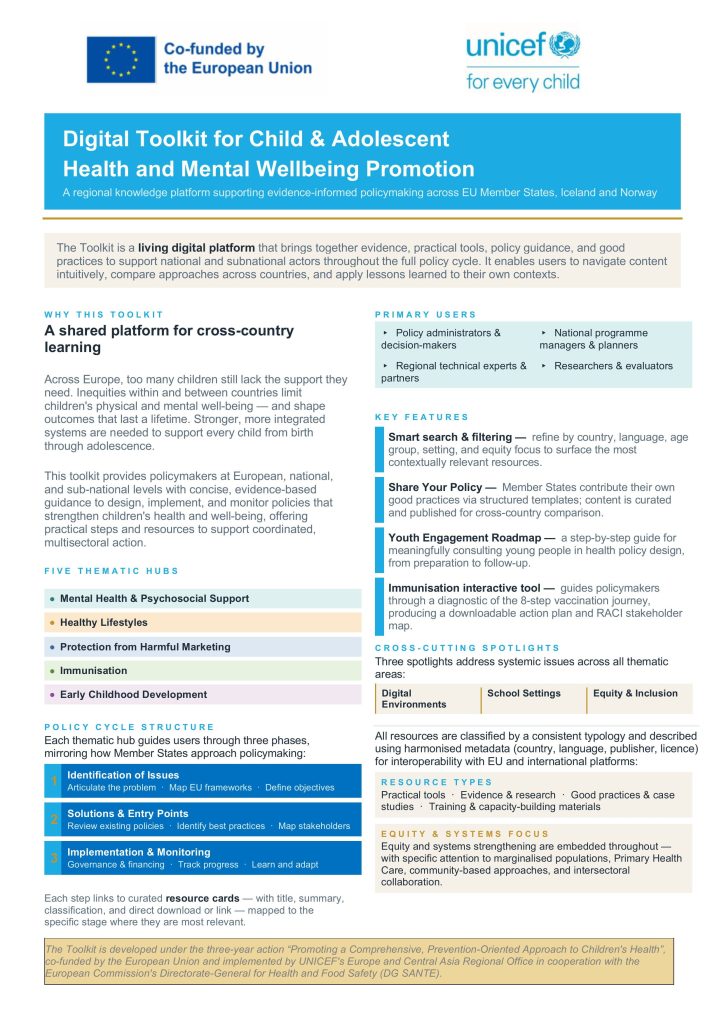
UNICEF’s Europe and Central Asia Regional Office, in cooperation with the European Commission’s Directorate-General for Health and Food Safety, is developing a new Digital Toolkit for Child and Adolescent Health and Mental Wellbeing Promotion. The toolkit is intended to support evidence-informed policymaking across EU Member States, Iceland and Norway. It will bring together policy guidance, evidence, practical tools and examples of good practice across five areas:
The platform is intended primarily for policymakers, programme managers, technical experts, researchers and evaluators.
Although the toolkit is aimed mainly at policy and programme audiences, paediatricians and paediatric trainees can provide an important clinical and frontline perspective. Your feedback can help ensure that the toolkit is:
The platform is intended primarily for policymakers, programme managers, technical experts, researchers and evaluators.

New ways to test high-risk medical devices.
Manufacturers of medical devices need to test their products before being allowed to market them. Specifically, they require clinical data showing their medical device is safe and efficient. In this context, the EU-funded CORE-MD project will translate expert scientific and clinical evidence on study designs for evaluating high-risk medical devices into advice for EU regulators. The project will propose how new trial designs can contribute and suggest ways to aggregate real-world data from medical device registries.
It will also conduct multidisciplinary workshops to propose a hierarchy of levels of evidence from clinical investigations, as well as educational and training objectives for all stakeholders, to build expertise in regulatory science in Europe. CORE–MD will translate expert scientific and clinical evidence on study designs for evaluating high-risk medical devices into advice for EU regulators, to achieve an appropriate balance between innovation, safety, and effectiveness. A unique collaboration between medical associations, regulatory agencies, notified bodies, academic institutions, patients’ groups, and health technology assessment agencies, will systematically review methodologies for the clinical investigation of high-risk medical devices, recommend how new trial designs can contribute, and advise on methods for aggregating real-world data from medical device registries with experience from clinical practice The consortium is led by the European Society of Cardiology and the European Federation of National Associations of Orthopaedics and Traumatology, and involves all 33 specialist medical associations that are members of the Biomedical Alliance in Europe.