5-6 December 2025

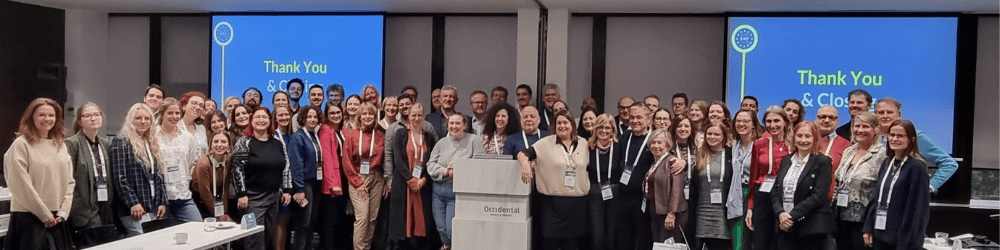
The EAP Winter Meeting 2025 in Prague brought together approximately 80 national delegates, council chairs, Strategic Advisory Groups (SAGs), Young EAP representatives, and the Executive Committee for two days of structured discussion, reflection, and decision-making. The meeting served as a key moment to consolidate progress made during 2025, address governance and communication flow in the organization, and align priorities for 2026 across education, advocacy, and public health.
The Meeting took place over two days and combined strategic discussion, governance, and thematic work. Friday focused on internal communication and training standards, followed by parallel Council meetings and short presentations from Strategic Advisory Groups and networks covering key priority areas, and concluded with a networking dinner to encourage cross-group exchange. Saturday was dedicated to governance, with the European Board of Paediatrics and EAP General Assemblies, including elections and statutory business, followed by open-door sessions of selected Strategic Advisory Groups and Young EAP to support wider participation and in-depth discussion of ongoing initiatives.
Throughout the meeting, several cross-cutting themes emerged across sessions and discussions:
These themes framed both the open discussions on Friday and the formal General Assembly on Saturday, and they continue to inform EAP’s work programme for 2026.
A part of the Winter Meeting was dedicated to governance reflection, building on feedback from delegates and experience gained over recent years. Delegates and leadership openly discussed areas where existing rules and procedures no longer sufficiently reflect the way EAP operates in practice.
The General Assembly formally endorsed the creation of a Statutes Revision Task Force which was proposed by EAP Leadership. This task force will work in close collaboration with external legal counsel to prepare a revised and legally robust framework aligned with Belgian non-profit law and current practices. Until revisions are completed, EAP will continue to operate in line with established practice to ensure continuity and stability.
Building on delegate feedback and experience gained over recent years, EAP leadership and National Delegates engaged in open and constructive discussion about how the Academy continues to evolve. These exchanges helped identify areas where existing rules and procedures can be further aligned with how EAP operates in practice today.
This work is already translating into concrete and exciting new developments, including:
Vaccination emerged as one of the most prominent thematic areas of the Winter Meeting, addressed through multiple formats: SAG presentations, open-door meetings, and a joint session involving YEAP and the REACH SAG.
Discussions highlighted:
The Vaccination SAG reported on ongoing collaboration with WHO, EMA, ECDC, and EU-funded projects, as well as recent scientific publications and advocacy activities. Topics discussed included:
A joint YEAP–REACH–Vaccination session further explored the concept of a European approach to vaccination documentation, identifying both technical and ethical challenges and outlining a first step through mapping national systems. Swiss involvement was particularly visible in this area, reflecting Switzerland’s expertise in migration, digital health, and cross-border care.
If the document doesn’t display properly, click here to open it in a new tab .

New ways to test high-risk medical devices.
Manufacturers of medical devices need to test their products before being allowed to market them. Specifically, they require clinical data showing their medical device is safe and efficient. In this context, the EU-funded CORE-MD project will translate expert scientific and clinical evidence on study designs for evaluating high-risk medical devices into advice for EU regulators. The project will propose how new trial designs can contribute and suggest ways to aggregate real-world data from medical device registries.
It will also conduct multidisciplinary workshops to propose a hierarchy of levels of evidence from clinical investigations, as well as educational and training objectives for all stakeholders, to build expertise in regulatory science in Europe. CORE–MD will translate expert scientific and clinical evidence on study designs for evaluating high-risk medical devices into advice for EU regulators, to achieve an appropriate balance between innovation, safety, and effectiveness. A unique collaboration between medical associations, regulatory agencies, notified bodies, academic institutions, patients’ groups, and health technology assessment agencies, will systematically review methodologies for the clinical investigation of high-risk medical devices, recommend how new trial designs can contribute, and advise on methods for aggregating real-world data from medical device registries with experience from clinical practice The consortium is led by the European Society of Cardiology and the European Federation of National Associations of Orthopaedics and Traumatology, and involves all 33 specialist medical associations that are members of the Biomedical Alliance in Europe.