EAP Contributes to EU Report on Overcoming Obstacles to Immunisation
April 28, 2026
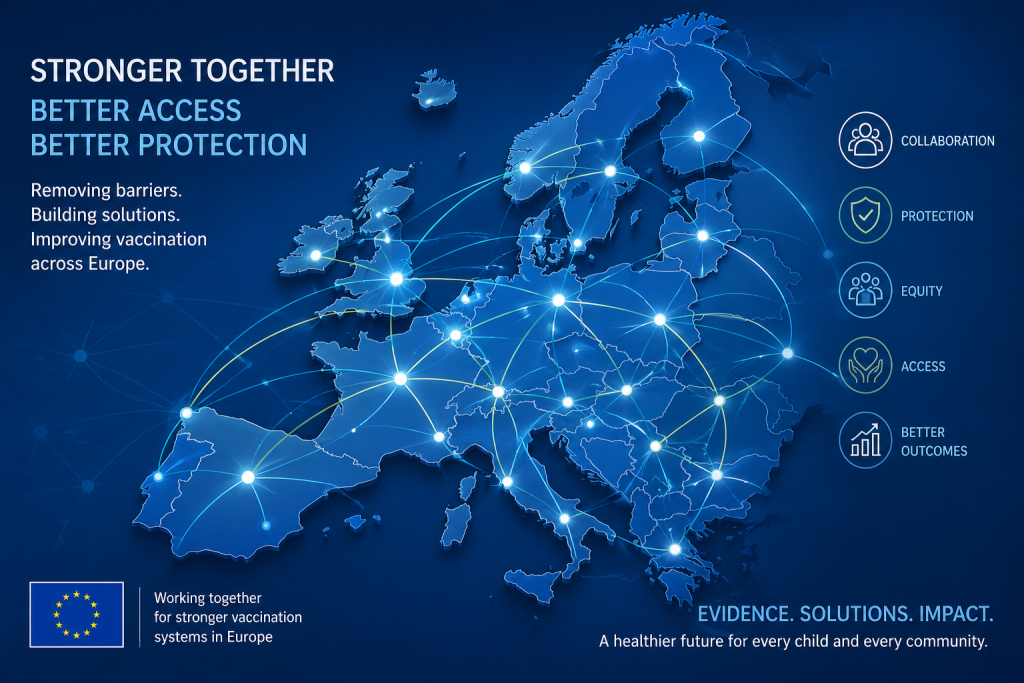
New EU Report Published: Strengthening Vaccination Access Through Practical Solutions
The European Academy of Paediatrics (EAP) is pleased to share that the final report of the EU-funded project Service contract to identify obstacles of physical, practical and administrative nature to develop recommendations has now been officially published by HaDEA and DG SANTE.
This important three-year project examined the practical, physical, and administrative barriers that can prevent children, adolescents, and adults across Europe from receiving recommended vaccinations. The project mapped vaccination services across all EU Member States, gathered evidence from citizens and healthcare professionals, identified promising practices, and tested practical solutions through pilot programmes.
The report highlights that vaccination uptake is not only influenced by vaccine confidence, but also by the way services are organised and delivered. Complex booking systems, limited opening hours, travel distance, lack of reminders, fragmented records, and insufficient outreach can all create barriers, even for families and individuals who are willing to be vaccinated.
Among the key approaches explored were reminder systems, mobile vaccination units, and school-based vaccination programmes. These solutions can help bring vaccination closer to communities, improve awareness of recommended schedules, reduce logistical difficulties, and support more equitable access.
For paediatricians, the findings are highly relevant. The report underlines the important role of healthcare professionals, including paediatricians, in actively recommending vaccination, guiding families through complex systems, and helping to ensure that children and adolescents do not miss opportunities for protection.
with EAP representatives Stefano del Torso, Łukasz Dembinski, and Stephen Reingold listed among the contributors to the Executive Summary.
EAP warmly thanks its representatives and all partners involved in this extensive project. Their expertise, commitment, and collaboration have contributed to a valuable European resource that can support future vaccination strategies and help strengthen child and public health across Europe.
"This achievement would not have been possible without EAP representatives valuable contributions, expertise, and commitment throughout the process - 3 years project .
It has been an amazing journey working together, and we want to sincerely thank you for the dedication and work you brought to this project, along with all the challenges faced and achievements accomplished along the way."
Verian Group
Verian is a purpose-led and independent research, evidence, evaluation, and communications agency, providing services to government and the public realm.
Your Enquiries Are Welcome
We will respond to you by Email
Core-MD Project
Coordinating Research and Evidence for Medical Devices (CORE-MD)
New ways to test high-risk medical devices.
Manufacturers of medical devices need to test their products before being allowed to market them. Specifically, they require clinical data showing their medical device is safe and efficient. In this context, the EU-funded CORE-MD project will translate expert scientific and clinical evidence on study designs for evaluating high-risk medical devices into advice for EU regulators. The project will propose how new trial designs can contribute and suggest ways to aggregate real-world data from medical device registries.
It will also conduct multidisciplinary workshops to propose a hierarchy of levels of evidence from clinical investigations, as well as educational and training objectives for all stakeholders, to build expertise in regulatory science in Europe. CORE–MD will translate expert scientific and clinical evidence on study designs for evaluating high-risk medical devices into advice for EU regulators, to achieve an appropriate balance between innovation, safety, and effectiveness. A unique collaboration between medical associations, regulatory agencies, notified bodies, academic institutions, patients’ groups, and health technology assessment agencies, will systematically review methodologies for the clinical investigation of high-risk medical devices, recommend how new trial designs can contribute, and advise on methods for aggregating real-world data from medical device registries with experience from clinical practice The consortium is led by the European Society of Cardiology and the European Federation of National Associations of Orthopaedics and Traumatology, and involves all 33 specialist medical associations that are members of the Biomedical Alliance in Europe.