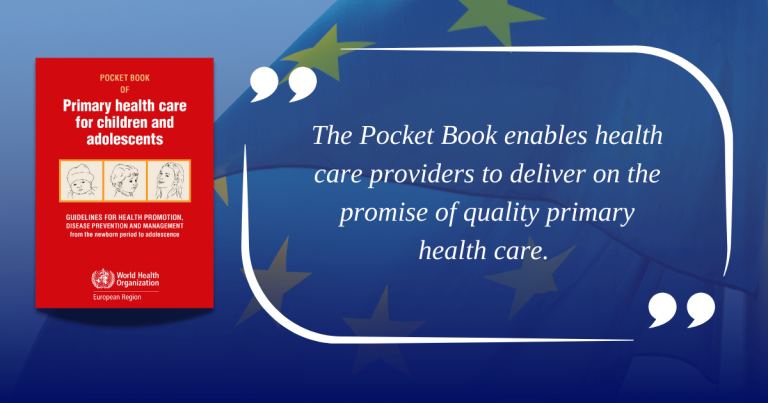
This WHO Pocket Book is a practical, evidence-based resource for doctors, nurses and other health professionals delivering primary health care to children and adolescents.
Designed for daily clinical use, it supports the assessment, management and referral of common conditions encountered at outpatient level, while promoting preventive and promotive care from the newborn period through adolescence. Clear guidance helps clinicians make informed decisions at the point of care, supporting safe, effective and timely management.
The Pocket Book strengthens the quality of primary care by encouraging the rational use of diagnostics, medicines and equipment, improving coordination with specialist services, and reducing unnecessary referrals and hospitalisations. Applicable across the WHO European Region, the guidance is designed to be adaptable to national contexts and will be regularly updated as new evidence emerges.
The Pocket Book is available online and accessible in multiple languages, supporting its use by diverse health care teams across Europe and beyond.
The European Academy of Paediatrics contributed to the development of this important resource. Stefano del Torso (EAP Executive Director), Zachi Grossman (National Delegate, Israel) and Peter Altorjai (National Delegate, Hungary) participated in its creation, with dissemination led by Iren Kantor, reinforcing EAP’s commitment to strengthening high-quality, evidence-based child health care across Europe.

New ways to test high-risk medical devices.
Manufacturers of medical devices need to test their products before being allowed to market them. Specifically, they require clinical data showing their medical device is safe and efficient. In this context, the EU-funded CORE-MD project will translate expert scientific and clinical evidence on study designs for evaluating high-risk medical devices into advice for EU regulators. The project will propose how new trial designs can contribute and suggest ways to aggregate real-world data from medical device registries.
It will also conduct multidisciplinary workshops to propose a hierarchy of levels of evidence from clinical investigations, as well as educational and training objectives for all stakeholders, to build expertise in regulatory science in Europe. CORE–MD will translate expert scientific and clinical evidence on study designs for evaluating high-risk medical devices into advice for EU regulators, to achieve an appropriate balance between innovation, safety, and effectiveness. A unique collaboration between medical associations, regulatory agencies, notified bodies, academic institutions, patients’ groups, and health technology assessment agencies, will systematically review methodologies for the clinical investigation of high-risk medical devices, recommend how new trial designs can contribute, and advise on methods for aggregating real-world data from medical device registries with experience from clinical practice The consortium is led by the European Society of Cardiology and the European Federation of National Associations of Orthopaedics and Traumatology, and involves all 33 specialist medical associations that are members of the Biomedical Alliance in Europe.