Ahead of the main congress in Lyon, our pre-congress courses offer an excellent opportunity to deepen your knowledge, strengthen practical skills, and engage in focused, high-quality training led by experienced faculty.
● Neonatal Cranial Ultrasound (CUS) ● Neonatologist Performed Echocardiography (NPE) ● Neonatal and Paediatric Vascular Access
Half-day paediatric courses
● Communication with Parents ● Paediatric Lung Ultrasound Course (POCUS)
The official academic course of the European Society for Emergency Paediatrics
● EMPOWER – EUSEM’s PrOfessional Workshop in Paediatric Emergency Response
Whether you are looking to refine your ultrasound skills, enhance emergency response competencies, or strengthen communication in clinical practice, the pre-congress courses provide valuable, hands-on learning in a focused setting.
Call for abstracts – Abstract submission deadline is approaching!
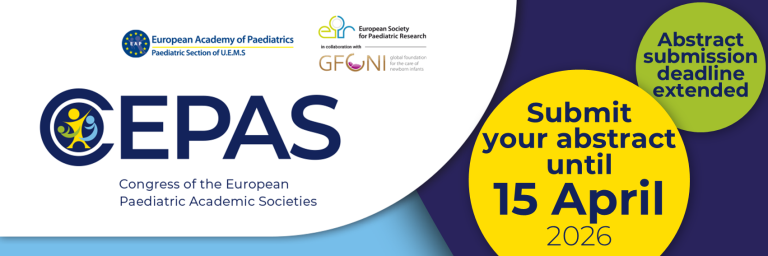
CEPAS is the ideal stage to present your research! Submit your abstract until 1 April 2026 and be part of the inaugural meeting of the European Academy of Paediatrics (EAP) and the European Society for Paediatric Research (ESPR) in close collaboration with the Global Foundation for the Care of Newborn Infants (GFCNI).
Follow us on social media to stay up to date with the latest news, deadlines, and community highlights! Be part of the CEPAS journey from the very beginning!
Contact the #CEPAS Team
Scientific Organisation European Academy of Paediatrics (EAP) Wwww.eapaediatics.eu European Society for Paediatric Research (ESPR) Wwww.espr.eu
Organiser EUROKONGRESS GmbH Schleissheimer Str. 2 80333 Munich, Germany T +49 (0)89 210 98 60 E[email protected]
Your Enquiries Are Welcome
We will respond to you by Email
Core-MD Project
Coordinating Research and Evidence for Medical Devices (CORE-MD)
New ways to test high-risk medical devices.
Manufacturers of medical devices need to test their products before being allowed to market them. Specifically, they require clinical data showing their medical device is safe and efficient. In this context, the EU-funded CORE-MD project will translate expert scientific and clinical evidence on study designs for evaluating high-risk medical devices into advice for EU regulators. The project will propose how new trial designs can contribute and suggest ways to aggregate real-world data from medical device registries.
It will also conduct multidisciplinary workshops to propose a hierarchy of levels of evidence from clinical investigations, as well as educational and training objectives for all stakeholders, to build expertise in regulatory science in Europe. CORE–MD will translate expert scientific and clinical evidence on study designs for evaluating high-risk medical devices into advice for EU regulators, to achieve an appropriate balance between innovation, safety, and effectiveness. A unique collaboration between medical associations, regulatory agencies, notified bodies, academic institutions, patients’ groups, and health technology assessment agencies, will systematically review methodologies for the clinical investigation of high-risk medical devices, recommend how new trial designs can contribute, and advise on methods for aggregating real-world data from medical device registries with experience from clinical practice The consortium is led by the European Society of Cardiology and the European Federation of National Associations of Orthopaedics and Traumatology, and involves all 33 specialist medical associations that are members of the Biomedical Alliance in Europe.