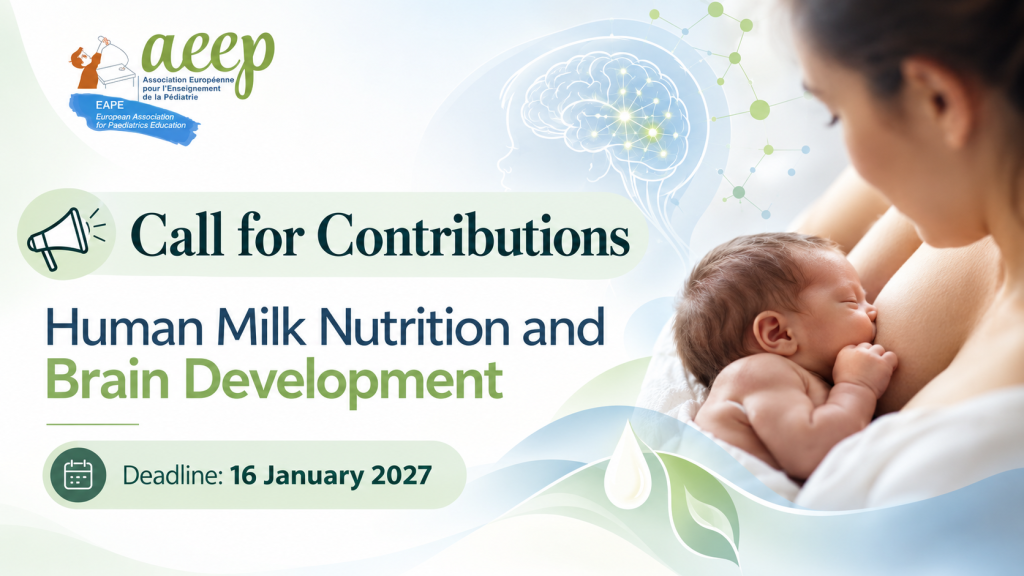
The European Association for Paediatrics Education (AEEP/EAPE) and Frontiers in Nutrition are inviting researchers, neuroscientists, nutritionists, paediatricians and others working in the field of human milk to contribute to the Research Topic “Human Milk Nutrition and Brain Development.”
Original research, reviews, clinical studies, translational work and mechanistic analyses are welcome, with interdisciplinary and innovative contributions particularly encouraged.
This Research Topic accepts the following article types, unless otherwise specified in the Research Topic description:
Brief Research Report
Case Report
Classification
Clinical Trial
Conceptual Analysis
Data Report
Editorial
FAIR² Data
General Commentary
Hypothesis and Theory
Methods
Mini Review
Opinion
Original Research
Perspective
Registered Report
Review
Study Protocol
Systematic Review
Technology and Code
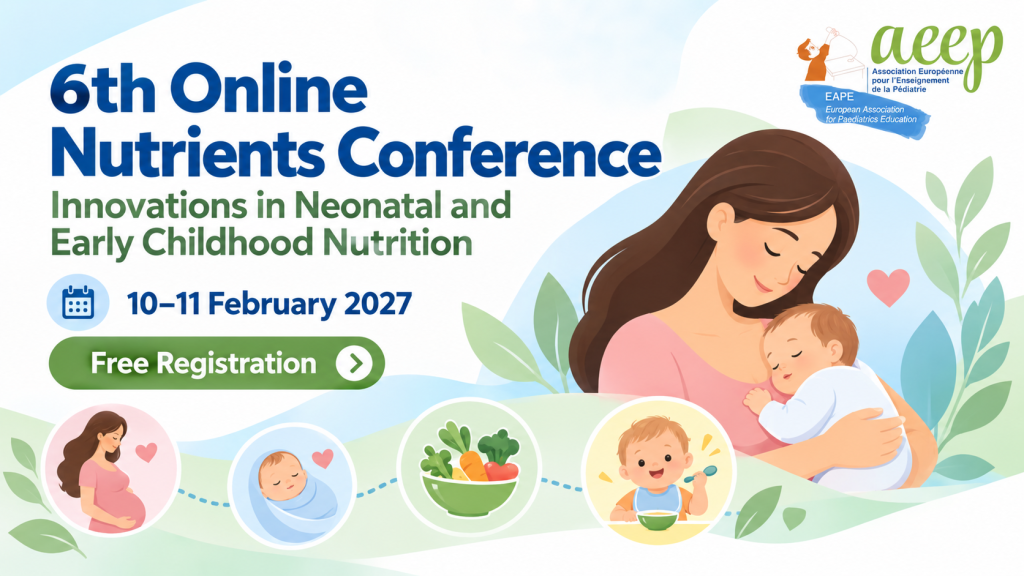
6th Online Nutrients Conference: Innovations in Neonatal and Early Childhood Nutrition 10–11 February 2027
AEEP/EAPE and INSA invite colleagues to the 6th Online Nutrients Conference, taking place 10–11 February 2027. Registration is free, and the programme will feature six sessions exploring current developments in neonatal and early childhood nutrition, including a dedicated session on Feeding Practice.
AEEP/EAPE and INSA invite colleagues to the 6th Online Nutrients Conference, taking place 10–11 February 2027. Registration is free, and the programme will feature six sessions exploring current developments in neonatal and early childhood nutrition, including a dedicated session on Feeding Practice.
Your Enquiries Are Welcome
We will respond to you by Email
Core-MD Project
Coordinating Research and Evidence for Medical Devices (CORE-MD)
New ways to test high-risk medical devices.
Manufacturers of medical devices need to test their products before being allowed to market them. Specifically, they require clinical data showing their medical device is safe and efficient. In this context, the EU-funded CORE-MD project will translate expert scientific and clinical evidence on study designs for evaluating high-risk medical devices into advice for EU regulators. The project will propose how new trial designs can contribute and suggest ways to aggregate real-world data from medical device registries.
It will also conduct multidisciplinary workshops to propose a hierarchy of levels of evidence from clinical investigations, as well as educational and training objectives for all stakeholders, to build expertise in regulatory science in Europe. CORE–MD will translate expert scientific and clinical evidence on study designs for evaluating high-risk medical devices into advice for EU regulators, to achieve an appropriate balance between innovation, safety, and effectiveness. A unique collaboration between medical associations, regulatory agencies, notified bodies, academic institutions, patients’ groups, and health technology assessment agencies, will systematically review methodologies for the clinical investigation of high-risk medical devices, recommend how new trial designs can contribute, and advise on methods for aggregating real-world data from medical device registries with experience from clinical practice The consortium is led by the European Society of Cardiology and the European Federation of National Associations of Orthopaedics and Traumatology, and involves all 33 specialist medical associations that are members of the Biomedical Alliance in Europe.